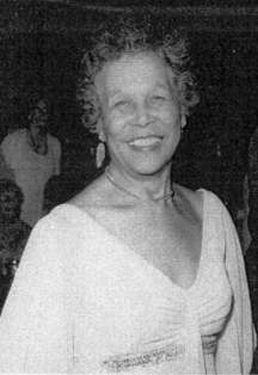
http://www.blackpast.org/files/blackpast_images/Clara_Stanton_Jones.jpg
Clara Stanton Jones (born May 14, 1913) was the first African American president of American Library Association, serving from 1976 to 1977. She was also appointed the director of the Detroit Public Library (1970–1978), becoming the first African American director of a major city public library in the United States.
Early life
Clara Stanton Jones was born on May 14, 1913 in St. Louis, Missouri to a close-knit, Catholic family. Her future career and impact in library science almost seemed predestined as she frequented the library at an early age. Jones recalls that she was one of the smallest patrons at the public library near her grandmother's house; she was also among very few black children at that local library. Although Jones had very little interaction with librarians in her young years, she read what interested her and selected her own materials. Her mother, Etta J. Stanton, worked as a school teacher, lecturing at public school systems until her marriage; Since the law did not allow married women to teach in the public school system, she taught in Catholic parochial schools to help support her family, including Clara Jone's endeavor to attend college. Jones' father, Ralph Herbert Stanton, was a manager at the Standard Life Insurance Company. He eventually accepted a position with the Atlanta Life Insurance Company where he worked until his death. Jones grew up in a highly segregated St. Louis neighborhood, but she was not daunted by the assumed, implicit Jim Crow laws; she instead regarded her young life to be privileged with all her primary mentors being African American.
Education and solidarity were heavily emphasized in Jones family; She obtained a well-rounded education even though the St. Louis public school system was completely segregated. She grew up in an entirely African-American world, with black role-models and mentors. In highschool, Jones aspired to become an elementary school teacher, even though her future salary would be slightly below white counterparts. This position would still provide a high standard of living for African Americans at that time because the income gap between white and black teachers was only slight. Jones was the first member of her family to graduate from college.
St. Louis was highly segregated, but instead of attending the local, tuition-free teachers college that was designated for black students, Jones attended the Milwaukee State Teacher’s College in 1930; she was inspired by her older brothers’ stories of college life away from home at Marquette University in Milwaukee, Wisconsin. Jones was one of only six black students at the college. She transferred to
Spelman College in Atlanta, Georgia, where she majored in English and History and decided to become a librarian instead of a teacher. The president Florence Reed caught notice of Jones' typing skills and offered her a position as a typist with the new Atlanta University Library; the librarians encouraged Jones to pursue a career in librarianship. She was highly receptive to their suggestions as she had already considered this career change.
Jones remained in that position until her graduation; she received her Bachelors of Art in 1934 from Spelman and a degree in Library Science in 1938 from the University of Michigan, Ann Arbor.
Career in Library and Information Science
Jones began working in libraries the same year she completed her degree in Library Science. She said that at the beginning of 1938, she worked in libraries at Dillard University, New Orleans, and Southern University, Baton Rouge, Louisiana. Jones spent the remainder of her librarian career at the Detroit Public Library, retiring in 1978 as the director. She was elected the first black president of the American Library Association after she accepted the position as head of the Detroit Public Library.
The Censorship of Racist and Sexist Library Materials In May 1977, Clara Stanton Jones, acting as president of the American Library Association, responded to the ALA Intellectual Freedom Committee’s (IFC) recommendation to quash the ALA’s “Resolution on Racism and Sexism Awareness” because its language remained unclear. Her response was published in the American Libraries, the official publication of the ALA. Jones opposed the IFC’s proposal, declaring that the resolution required further adjustments and amendments to the language before the committee considers annulment. The IFC feared that the resolution favored censorship as a means to purge library materials of racist and sexist language, and thereby opposing the Library Bill of Rights pledge to sustain access to information and enlightenment despite content, and encourage libraries to challenge censorship.
The ALA made the decision to deliberate the fate of the resolution and report its results at the 1977 Detroit conference. Jones asserted that the resolution did not conflict with the Library Bill of Rights, and instead promoted awareness by encouraging training and outreach programs in the libraries and library schools. In agreement with the Library Bill of Rights, she advocated for more enlightenment, not repression, to combat the effects of racism and sexism in library materials. Jones viewed the resolution as the framework, and not the final solution, for enabling librarians to confront issues that hampered “human freedom”.
“The spirit of the “Resolution on Racism and Sexism Awareness” is not burdened with repression; it is liberating. If the resolution is imperfect, try to make it perfect, but not by destroying it first!” - Clara Stanton Jones.
Jones served as the director for Detroit Public Library from 1970 to 1978, becoming the first African American to head a major public library in the United States.
She served as the first black president of the American Library Association in 1976 to 1977. During her presidency, she heavily aided the ALA adoption of a "Resolution on Racism and Sexism Awareness" to encourage librarians to raise the awareness of library patrons and staff to problems of racism and sexism.
She advocated the passing of the "Resolution on Racism and Sexism Awareness" in 1977 despite the ALA's Intellectual Freedom Committee's recommendation to the ALA Executive Board that the resolution be rescinded.
President Jimi Carter appointed Jones as Commissioner to the National Commission on Libraries and Information Science in 1978. She served this post until 1982.
Jones received the Trailblazer Award in 1990 from the Black Caucus of the ALA, the highest award given by BCALA. The award recognizes individuals whose pioneering contributions have been outstanding and unique, and whose efforts have "blazed a trail" in the profession.
Jones founded the discussion group, Black Women Stirring the Waters
Black Caucus of the American Library Association
Social Responsibilities Round Table
Jones, C. S. (1974). Library service to the disadvantaged: Means and methods: a session from the 92nd Annual Conference of the American Library Association, Las Vegas, June 24–30, 1973. Phonotape. Development Digest.
Jones, C. (1977). ALA President Views the Racism/Sexism Resolution. American Libraries, 8(5), 244. Retrieved from Academic Search Premier database.
Josey, E. J., & Jones, C. S. (1978). The information society: Issues and answers : American Library Association's Presidential Commission for the 1977 Detroit Annual Conference. London: Oryx Press.
Dowlin, K. E., & Jones, C. S. (1987). How to computerize your community information and referral files. Ballwin, MO: ACTS.
Hernandez, E., Smith, E. M., & Jones, C. S. (1988). Librarians as colleagues across racial lines Strategies for action. Ballwin, Mo: ACTS.
Jones, C. S. (1992). From grassroots Outreach makes it happen. Chicago, Ill.: American Library Association.
"Libraries were a part of my life from the very beginning."
"Librarians organize knowledge, information of any kind. We can make it accessible to people."
"Dr. DuBois would say, "Clara, what are you reading now, and what do you think of it?(of something that he had recommended). He really was very inspiring to me."
"When ALA first asked me if I would run for president, I said, "That's the last thing in the world I want to do, conduct a Council meeting with everybody shouting, "Point of order!""
"I really felt in touch with the people in our own race who were the achievers. They came through to us as real people."
"It never dawned on me to doubt my ability as far as race was concerned."



 Postagens

