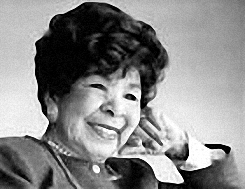
Augusta Baker is one of those names that should be spelled out in dazzling lights in every single children's room in every single library in the United States. Storyteller, author, compiler, activist, and children's librarian, her influence on programming and collection development policies in public libraries cannot be underestimated. The stories in her collections (The Talking Tree, The Golden Lynx, etc.) are fine examples of "the tellable tale" and her book on storytelling (Storytelling: Art and Technique, with Ellin Greene) is arguably the most influential book on storytelling in libraries ever published.
Augusta Braxton Baker was an African-American librarian and storyteller, renowned for her contributions to children’s literature
Early life and education
Augusta Braxton Baker was born on April 1, 1911 in Baltimore, Maryland. Both of her parents were schoolteachers, who instilled in her a love of reading. During the day while her parents worked, her grandmother, Augusta Fax (from whom she received her name) cared for and told her stories. Baker delighted in these stories, carrying her love for them throughout her life. She learned to read before starting elementary school, later enrolling in the (racially segregated) black high school where her father taught, and graduating at the age of 16. Baker then entered the University of Pittsburgh, where she both met and married James Baker by the end of her sophomore year. Relocating with her husband to New York, Baker sought to transfer to Albany Teacher’s College (now the State University of New York at Albany), only to be met with racial opposition from the college. It was then the wife of Franklin Roosevelt (who was then the Governor of New York), Eleanor, who was on the board of the Albany Interracial Council (now the Albany Urban League) and heavily advocated for Baker’s successful transfer. Though the college did not want to admit blacks, they also did not want to oppose the governor's wife, and Baker was admitted. She completed her education there, earning a B.A. in education in 1933 and in 1934 became the first African American to graduate from the college with a B.S. in library science.
Professional career
After graduation, Baker taught for a few years, until she was hired in 1937 as the children's librarian at the New York Public Library's 135th Street Branch (now the Countee Cullen Regional Branch) in Harlem.
In 1939, the branch began an effort to find and collect children's literature that portrayed black people as something other than "servile buffoons," speaking in a rude dialect, and other such stereotypes. This collection, founded by Baker as the James Weldon John Memorial Collection of Children's Books, led to the publication of the first of a number of bibliographies of books for and about black children. Baker furthered this project by encouraging authors, illustrators, and publishers to produce, as well as libraries to acquire, books depicting blacks in a favorable light.
In 1953, she was appointed Storytelling Specialist and Assistant Coordinator of Children's Services. Not long after that, she became Coordinator of Children's Services in 1961, becoming the first African-American librarian in an administrative position in the New York Public Library. In this role, she oversaw children's programs in the entire NYPL system and set policies for them. During this time, Baker also figured prominently in the American Library Association's Children's Services Division (now the Association for Library Service to Children), having served as its president. Additionally, she chaired the committee that awarded the Newbery Medal and the Caldecott Medal. Furthermore, Baker influenced many children's authors and illustrators—such as Maurice Sendak, Madeleine L'Engle, Ezra Jack Keats, and John Steptoe--while in this position. She also worked as a consultant for the then newly created children's television series Sesame Street.
In 1974, Baker retired from the New York Public Library. However, in 1980, she returned to librarianship to assume the newly created Storyteller-in-Residence position at the University of South Carolina; this was also the first such position in any American university at the time. She remained there until her second retirement in 1994. During her time there, Baker cowrote a book entitled Storytelling: Art and Technique with colleague Ellin Green, which was published in 1987.
Death and continued legacy
After a long illness, Baker died at the age of 86 on February 23, 1998. Her legacy has remained even today, particularly through the "A(ugusta) Baker’s Dozen: A Celebration of Stories" annual storytelling festival. Sponsored by the University of South Carolina College of Library and Information Science and the Richland County Public Library, this festival originated in 1987 during Baker’s time at the University, and is celebrated still to this day.[4]
Her legacy also continues through the Augusta Baker Collection of Children's Literature and Folklore at the University of South Carolina. The collection, donated by her son, James H. Baker III, contains over 1,600 children's books, including materials from her personal and working library, as well as papers, illustrations, and anthologies of folktales Baker used during her career.[5]
Awards and honors
- First recipient of the E.P. Dutton-John Macrae Award (1953)
- Parents Magazine Medal Award (1966)
- ALA Grolier Award (1968)
- Women's National Book Association, Constance Lindsay Skinner Award (1971)
- Clarence Day Award (1975)
- Honorary ALA Membership (1975)
- Honorary Doctorate from St. John's University (1980)
- Catholic Library Association's Regina Medal (1981)
- Honorary Doctorate from the University of South Carolina (1986)
- Second recipient of ALSC Distinguished Service Award (1993)
Bibliography
- From Janice M. Del Negor, former Editor of The Bulletin for Children's Books:
- Baker, Augusta. 1955. Talking tree; fairy tales from 15 lands. Illus. by Johannes Troyer. Philadelphia, PA: J.B. Lippincott.
- Courlander, Harold. 1956. Uncle Bouqui, folk tales from Haiti; from Uncle Bouqui of Haiti. Read by Augusta Baker. Sound recording. Washington, DC: Folkways Records.
- Baker, Augusta. 1957. Books about Negro life for children. New York, NY: New York Public Library.
- Baker, Augusta, ed. 1960. Golden lynx, and other tales. Illus. by Johannes Troyer. Philadelphia, PA: J.B. Lippincott.
- Baker, Augusta, ed. 1960. Young years; best loved stories and poems for little children. New York, NY: Parents' Magazine Educational Press; Home Library Press.
- Baker, Augusta. 1961. Books about Negro life for children. New York, NY: New York Public Library.
- Baker, Augusta. 1963. Books about Negro life for children. New York, NY: New York Public Library.
- Baker, Augusta. 1963. Young years library. New York, NY: Parents' Magazine Educational Press.
- Baker, Augusta, et al. 1966. Come hither! : papers on children's literature and librarianship. Los Angeles, CA: Yeasayers Press.
- Baker, Augusta. 1967. Aids to choosing books for children. New York, NY: Children's Book Council.
- Rollins, Charlemae Hill. 1967. We build together; a reader's guide to Negro life and literature for elementary and high school use. With contributions from Augusta Baker, et al. Champaign, IL: National Council of Teachers of English.
- Baker, Augusta, ed. 1971. Black experience in children's books. Cover design by Ezra Jack Keats. New York, NY: New York Public Library.
- Baker, Augusta. 1975. Storytelling. Cassette recording. New York, Children's Book Council.
- Baker, Augusta and Ellin Greene. 1977. Storytelling : art and technique. New York, NY: R. R. Bowker.
- Baker, Augusta and Ellin Greene. 1987. Storytelling : art and technique, 2nd ed. New York, NY: R. R. Bowker.
- Green, Ellin. 1996. Storytelling : art and technique. With a foreword by Augusta Baker. New York, NY: R. R. Bowker.
http://en.wikipedia.org/wiki/Augusta_Braxton_Baker
http://www.blackscholarsindex.com/2010/03/augusta-baker-storyteller-librarian-authority-on-childrens-literature-and-legend/
http://kids.nypl.org/parents/ocs_centennial_baker.cfm



 Postagens

